What Does CBN Do To You?
You have likely heard the whispers about cannabinol. It is often branded as the "sleepy cannabinoid" or the ultimate nightcap. But reducing CBN to a simple sedative glosses over the nuance of its character.
This compound is actually a byproduct of time. It is what happens when THC ages, oxidizes, and settles into a different chemical structure. That origin story defines its effects. CBN, or cannabinol, is not quite the non-intoxicating safety net of CBD, nor is it the euphoric rocket ship of Delta 9 THC.
It exists in a unique middle ground.
This guide focuses strictly on the immediate experience. We are not here to discuss long-term wellness plans or therapeutic claims about insomnia. Those details belong in our Benefits section. Instead, we are exploring the raw data of sensation.
What happens in the thirty minutes after you take a CBN tincture? How does the texture of your thoughts change? Does it actually make you feel high, or just heavy? We will strip away the marketing fluff to examine the physiological and cognitive reality of CBN.
Understanding these effects is critical because this cannabinoid feels distinct. It has a specific weight and gravity that sets it apart from its chemical cousins.

From THC to CBN: The aging process.
What Are the Effects of CBN?
The effects of cannabinol are best described as a lowering of the volume. While other cannabinoids might turn up the brightness on your senses or sharpen your focus, CBN tends to dim the lights. The immediate impact is usually physical, but it quickly bleeds into the mental state.
Most users report a distinct shift in their energy levels within an hour of consumption. The intensity of these effects depends entirely on your tolerance to THC and your current body chemistry.
For a complete novice, even a moderate dose of CBN can feel surprisingly potent. For a seasoned cannabis user, it might register merely as a subtle relaxation. However, the nature of the effect remains consistent. It is a downward shift. It is a grounding force. The experience is rarely energetic or stimulating.
How It Affects The Body
Your body is the first place you will notice CBN taking hold. The sensation often starts in the shoulders or behind the eyes. Tension you were not even aware of begins to dissolve. It is not necessarily the active muscle release you might get from a high dose of CBD; it feels more like a passive heaviness.
Users often describe a "weighted blanket" sensation. Your limbs might feel slightly denser. The urge to move around decreases significantly. If you are sitting on the couch, the couch becomes much more comfortable. If you are lying in bed, the mattress seems to rise up to meet you. This physical sedation is the hallmark of the compound.
Appetite changes can occur, though they manifest differently than the ravenous "munchies" associated with Delta 9 THC. You might find yourself wanting a snack, but you likely will not have the motivation to cook a meal. The physical lethargy usually wins out over the hunger. The body enters a state of conservation.
Heart rate remains relatively steady, avoiding the acceleration that sometimes accompanies THC, which helps reinforce that overall sense of physical calm.
How It Affects The Brain & Mood
While the body gets heavy, the brain gets quiet. The cognitive effects of CBN are perhaps its most sought-after trait. Racing thoughts tend to slow down. The mental checklist of tomorrow’s tasks starts to fade into the background. It functions like a physiological "off" switch for a busy mind.
This is not to say it makes you dull or incapable of thought. You are simply less interested in complex problem-solving. The mood shift is generally one of apathy toward stress. Things that might normally irritate you or demand your mental attention seem less urgent.
It interacts with both CB1 and CB2 receptors in the endocannabinoid system, but its affinity for the CB1 receptor is much lower than that of THC. This weak binding is why the mental experience is sedating rather than psychoactive in the traditional sense.
You do not get the rush of ideas or the alteration of time perception. You get silence. You get a mental pause. This unique interaction profile is why many users stack it with other cannabinoids to modulate the experience, but on its own, CBN is a solitary, quiet compound.
Common Short-Term Side Effects
No substance is without its cost. CBN is generally well-tolerated, but the very traits that make it desirable can also become its drawbacks. The most common side effect is essentially "too much of a good thing."
- Drowsiness: If you take CBN and attempt to remain active or social, you will likely feel sluggish and disconnected.
- Grogginess: This can morph into grogginess the next morning. Some users report a "hangover" effect where the brain fog persists for the first hour after waking up.
- Dry Mouth & Eyes: Since CBN is a degradation product of THC, it shares this dehydrating characteristic.
- Dizziness: You might also experience mild dizziness if you stand up too quickly, as your blood pressure may lower slightly as you relax.
These effects are transient. They typically fade as the compound leaves your system, but they are worth noting if you have a busy morning scheduled.
Visualizing the "weighted blanket" effect.
What Does It Feel Like?
Imagine you have just finished a long hike. You are physically tired, but it is a "good" tired. You sit down in a comfortable chair and realize you have absolutely no intention of standing up again for a long time. That is the baseline CBN experience.
The feeling is grounded. It is heavy. Unlike the "heady" buzz of a sativa strain, CBN resides in the body. Your eyelids feel physically heavier. Blinking becomes a slower process. There is a sense of detachment from the outside world.
Mentally, it feels like the transition from wakefulness to sleep. It captures that twilight state where thoughts become abstract and less linear. You do not feel confused or intoxicated, but you do feel slow. It creates a barrier between you and external stimuli.
A loud noise might not startle you as much. A bright light might seem less abrasive. The world softens around the edges.
Strength is a key variable here. A low dose (5mg) might just take the edge off a stressful day. A high dose (20mg+) can feel almost narcotic in its sedation for some users. The feeling is rarely euphoric; it is content. You are not happy or sad; you are simply at rest.
Does It Get You High?
This is one of the most common questions, and the answer requires a bit of nuance. The short answer is: generally, no. But the accurate answer is: it depends on who you are and how much you take.
CBN is mildly psychoactive. It is roughly one-quarter the potency of THC. In standard commercial doses, it does not produce a "high" that impairs function or alters reality. You will not hallucinate. You will not get the giggles. You will not lose track of where you are.
However, because CBN comes from THC, it retains a shadow of that intoxicating profile. If you consume a massive amount of CBN, you may feel a "stoney" sensation. This is distinct from the soaring high of Delta 9. It is more of a disorienting fog. You might feel slightly out of it.
For individuals who are extremely sensitive to cannabinoids, even small amounts of CBN can feel slightly intoxicating. But for the vast majority of users, CBN is non-intoxicating. It is psychoactive only in the sense that it alters your mood and sedation levels, not your perception of reality. It sits closer to CBD on the intoxication spectrum, but it leans just enough toward THC to be noticeable.
How Does CBN Compare to Other Cannabinoids?
Understanding CBN requires context. We need to see how it stacks up against the other major players in the cannabinoid lineup.
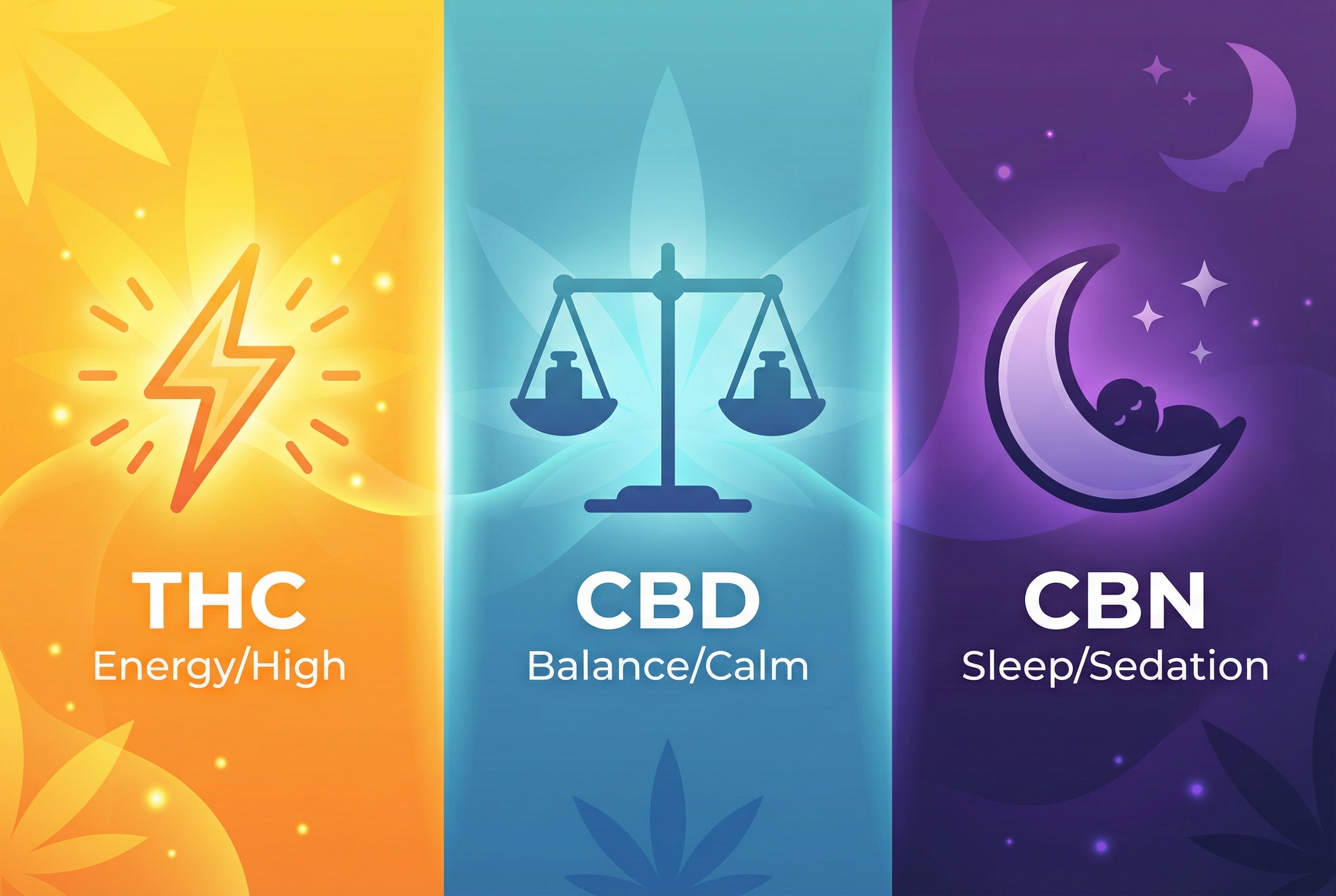
CBN vs. CBD: CBD is often described as alert calm. You can take CBD in the morning with your coffee. It balances you without dragging you down. CBN is the opposite. It is sedative calm. You would not take CBN before a meeting. Physically, CBD releases tension; CBN adds weight.
CBN vs. THC: THC is the life of the party; CBN is the end of the party. THC stimulates the mind, enhances sensory input, and creates euphoria. CBN dampens sensory input and promotes apathy. If THC is a firework, CBN is a dimmer switch. The "high" from THC is cerebral and active. The sensation from CBN is somatic and passive.
CBN vs. Delta 8: Delta 8 is a middle ground, offering a lighter version of the THC high with some body relaxation. CBN lacks the euphoria of Delta 8. Delta 8 is for relaxing recreation; CBN is for functional sedation.

Comparing Cannabinoid Effects
Effects: Key Takeaways
If you are considering adding CBN to your routine, keep these core realities in mind.
- It is the master of sedation. No other cannabinoid competes with CBN for pure relaxation and heaviness.
- It is not a daytime compound. Unless you plan on napping, save this for the evening.
- It won't get you "high." While technically psychoactive, it does not produce the intoxication of THC.
- It feels heavy. The sensation is physical, often described as a weighted blanket for the mind and body.
- It is distinct from CBD. Do not expect the mental clarity of CBD. Expect a foggy, comfortable slow-down.
Frequently Asked Questions
How long do the effects of CBN last?
The duration of CBN effects largely depends on how you consume it. If you use a sublingual tincture, the effects can last anywhere from 4 to 6 hours. If you consume a CBN edible or capsule, the effects are prolonged as the body processes the compound through the liver, often lasting 6 to 8 hours. This duration is why morning grogginess is a common side effect; if you take it too late at night, it may still be active when your alarm goes off.
How fast do effects start?
Onset time is determined by delivery method. Inhaled CBN (vapes) works almost instantly, with effects peaking within 15 to 30 minutes. Tinctures held under the tongue typically kick in within 30 to 45 minutes. Edibles are the slowest, requiring 45 minutes to 2 hours to fully feel the weight of the sedation.
Can you feel too much of CBN?
Yes, you can. While it is not toxic, taking too much CBN can result in an uncomfortable level of drowsiness, disorientation, and extreme dry mouth. You may feel "glued" to the couch in a way that feels restrictive rather than relaxing. The "hangover" effect the next day is the most reliable indicator that your dose was too high.
Will this cannabinoid make me fail a drug test?
This is a critical risk area. Because CBN is a degradation product of THC, it is structurally very similar. Many standard drug tests look for THC metabolites. There is a high probability that CBN can trigger a false positive on a urinalysis. Additionally, many CBN products contain trace amounts of THC due to the extraction process. If your job depends on a clean test, you should avoid CBN.
Do edibles vs tinctures vs vapes feel different?
The core feeling of sedation remains, but the "texture" of the experience changes. Vapes provide a sudden wave of heaviness that is intense but shorter-lived. Tinctures offer a smoother, more controlled onset. Edibles tend to produce the heaviest body load. The edible experience is often deeper and more all-encompassing, making it the preferred method for those seeking sustained rest through the night.